
A labor market that has changed dramatically
Over the past few years, Belgium experienced an employee-driven labor market. Companies were struggling to find talent, vacancies were abundant, and candidates often had multiple opportunities to choose from.
That situation has shifted.
Vacancy numbers declining
The labor market in Flemish Brabant has cooled noticeably, with the overall volume of job vacancies decreasing by 9.7% compared to a year ago.
The change is particularly significant in office-oriented and knowledge-based sectors, including IT, media, and financial services, where vacancy volumes have fallen substantially over the past year, both in Flemish Brabant and across Flanders.
Increase in job seekers
While vacancy numbers have declined, the number of active job seekers in Flemish Brabant has risen significantly, increasing by approximately 10% over the past year. As a result, the province's unemployment rate was at 5.4% as of April 2026.
The pressure on the labor market is being intensified by recent changes to Belgium's unemployment benefit system. As eligibility rules have tightened and unemployment benefits are gradually being limited in duration, more people are actively re-entering the job market.
This has contributed to a significant increase in the number of job seekers, many of whom bring considerable experience and strong language skills, creating greater competition for a shrinking number of vacancies.
The result is a labor market that is not only generating fewer opportunities, but is also seeing a growing influx of candidates actively searching for work.
Employers are more cautious
Economic uncertainty, rising operating costs, and international pressures have made many employers more cautious. Across Flemish Brabant, the number of open vacancies has declined, while the number of active job seekers has increased. Employers who previously needed to hire quickly now have greater choice and are becoming more selective in their recruitment processes.
For international professionals, this creates a particularly challenging environment.
Not only are there fewer English-speaking entry-level opportunities available, but competition for those roles is increasing considerably.
The Silver Lining
While there are more people entering the labor market and fewer positions are becoming available, there is a silver lining.
In January 2026, the jobseeker rate in Flemish Brabant stood at 5.7%, compared with 7.1% for Flanders as a whole. Flemish Brabant therefore remains one of the strongest-performing labor market regions in Flanders, with a jobseeker rate that is approximately 20% lower than the Flemish average.
The Leuven paradox
When people think of Leuven, they often think of KU Leuven, imec, startups, and a vibrant international community.
And they are right.
But there is a paradox.
Leuven is internationally oriented, yet much of the local labor market still depends on strong local networks and knowledge of the national languages.
Many of the most attractive roles, particularly in technology and knowledge-intensive sectors, never fully reach public job boards. They are filled through referrals, existing professional relationships, recruiters, and internal networks. This is often referred to as the "hidden" or "invisible" labor market.
For newcomers, this can be frustrating. It can feel as though opportunities exist, but remain difficult to access.
This is why networking is not simply a nice-to-have activity in Belgium. It is often a critical part of the job search process.
The challenge, of course, is that networks take time to build.
The language question
One of the most common questions we hear is:
"Do I really need Dutch?"
The honest answer is: it depends on the role, but increasingly, yes.
While many companies operate internally in English, a large part of the broader Flemish labor market still prioritizes knowledge of Dutch and sometimes French.
This is especially true in customer-facing, service-oriented, and SME environments.
In a more competitive labor market, employers often return to language requirements as a way to narrow down candidate pools. As a result, learning Dutch is not just about communication. It significantly increases access to opportunities.
The good news?
You do not need perfect Dutch before starting your career journey. But consistently investing in language learning can make a substantial difference over time.
IHL offers language practice opportunities and tips for learning a new language.
Looking beyond the obvious opportunities
Many internationals focus exclusively on tech companies, research institutions, or multinational employers.
These remain important pathways, but they are not the only ones.
The airport and logistics region around Zaventem and Vilvoorde offers opportunities in supply chain, engineering, operations, and international business.
Meanwhile, many local SMEs are looking for skilled professionals, even if accessing those opportunities often requires stronger language skills and local connections.
Sometimes the most successful career transition starts with broadening the search rather than narrowing it.
The AI factor
Another trend that cannot be ignored is the growing impact of artificial intelligence.
Roles in translation, customer support, basic administration, and certain junior office functions are changing rapidly. These have traditionally been entry points for many international professionals, particularly those who speak multiple languages.
As AI takes over routine tasks, employers increasingly seek candidates who combine technical expertise, adaptability, communication skills, and local market knowledge.
This makes networking, continuous learning, and language acquisition even more important.
A realistic but hopeful message
The current labor market can be tough.
It may take longer than expected to find the right opportunity.
Building a network takes time.
Learning Dutch takes time.
Establishing yourself professionally in a new country takes time.
But none of those efforts are wasted.
Every networking conversation, every language class, every volunteer role, internship, practical project, or professional introduction helps build the local connections that are often the key to future opportunities.
For internationals in and around Leuven, success is rarely just about submitting more applications.
It is about becoming part of the ecosystem.
Keep learning the language. Keep meeting people. Keep showing up.
The path may be longer than anticipated, but those investments often create opportunities that no online job board can offer.
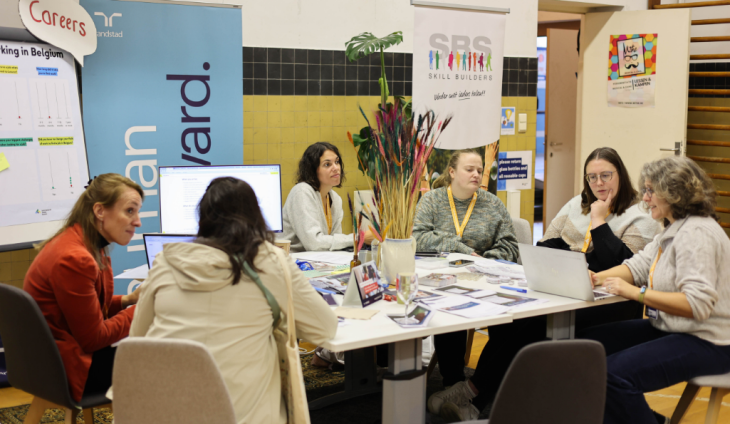
IHL is here to support internationals who are looking for a career. We provide free career workshops and bootcamps to help people establish a network, understand the labor market, improve their CV for the Belgian context, provide Dutch practice opportunities, and more.
All events related to careers can be found here.
Check out our Work & Volunteer section in our Info Hub for more information about finding work in Belgium.
Resources
Contributions
Randstad Belgium
Sandrien Rombaut, Project Manager Employability at Randstad Belgium
Greetje Allaert, National Advisor Employability at Randstad Belgium